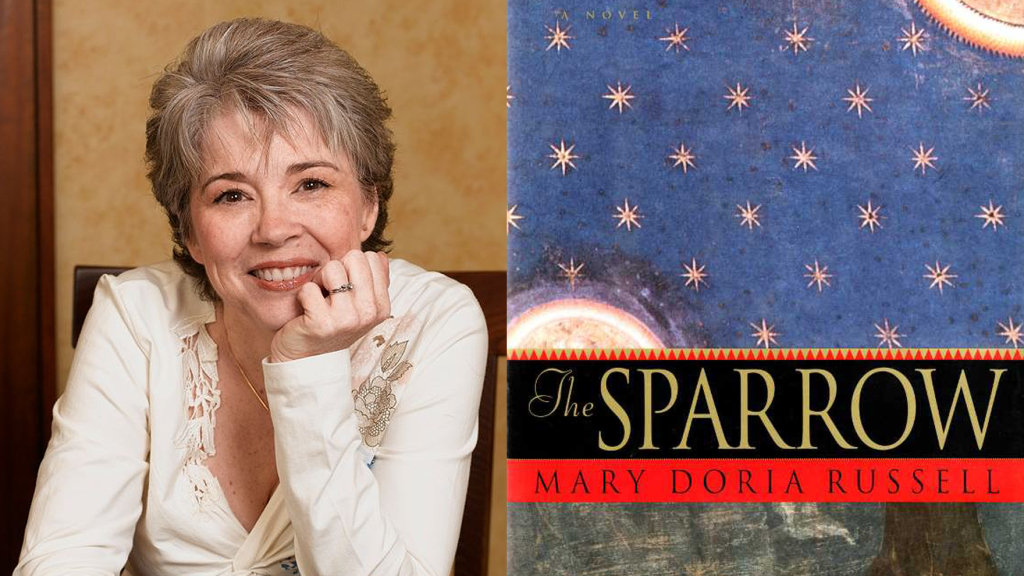
Celebrating 30 Years of The Sparrow: A Q&A with Mary Doria Russell
Three decades after its debut, the author reflects on her award winning debut novel.
February 23 2026
This year marks the 30th anniversary of The Sparrow, first published on September 9, 1996. A novel that has captivated readers for decades with its powerful exploration of faith, first contact, and the fragile limits of human understanding, it reached a new audience last year with a reprint from The Broken Binding, giving readers the chance to rediscover Mary Doria Russell’s unforgettable story.
To celebrate this milestone, we reached out to Mary Doria Russell for an exclusive email Q&A. In the conversation below, available only on The Sparrow Source, Russell reflects on the book’s legacy, the creative journey behind it, and what the story means to her thirty years on.
Were there moments when a character surprised you by taking the story in an unexpected direction?
Definitely. As
The Sparrow took shape, I was thinking there might be a scene where Sofia approached Emilio. I even knew the line from Shakespeare that I could steal: “Emilio, serve God. Love me.” But when I got to that point in the story, Sofia said, “I would never do that. I respect his commitment and I would never risk his rejection. But, you know… Jimmy has grown up quite a bit.”
I swear: my immediate reaction was, “He’s too tall for you!” That’s the shallow level my conscious mind was operating on. But here’s the thing: you know your characters have their own integrity when they refuse to do something that’s literally out of character. So I backed off and let myself consider Sofia’s suggestion. And maybe she and Jimmy were not a couple that would have worked on Earth, but on Rakhat? Maybe Jimmy is the right man in the right place at the right time.
Looking back, she has had three good men to serve as bridges to healing. George, DW, and Emilio. Their respect and affection helps her get to where she can accept and value and return Jimmy’s love.
The books list a few of the Rakhati months (Na’alpa, Partan, Stan’ja and Fra’an), and mention Rakhati years being longer than those on Earth. Did you plan a full calendar while world building? How did you imagine their years passing on a planet with three suns?
Nope, I didn’t think about things like calendars. And honestly, until you asked this question, I never thought about how the annual cycle would operate.
At the time, I assumed that a three-star system like Alpha Centauri wouldn’t be a realistic candidate for planets. I figured the weird gravity fluctuations would rip apart any aggregation of material that might have gone into making a planet. But, whatever! That’s the fiction part of science fiction, like traveling at a substantial percentage of the speed of light to get to a fictional planet. To my surprise, the latest astronomy interpretation is that there a planet in the AC system.
In any case, I wasn’t building a world, I was telling a story. I started with the human relationships, not the planetary environments.
Are there aspects of the Runa and Jana’ata cultures, language and customs that you would like to have explored further, but couldn’t?
Children of God is the answer to that question. I believed that
The Sparrow could stand alone, and I certainly didn’t plan to write a sequel to a novel I hadn’t planned to write, I did have a lot of other ideas about how the story would look from the VaRakhati point of view. About a month after
The Sparrow was completed, Celestina appeared and
Children of God was under way.
Lots of babies in that book. Even the guinea pig has babies. Children are revolutionary.
Both novels weave together multiple timelines and perspectives. How did you keep track of the narrative threads? Did you use any tools (charts, timelines, etc) to organise the story?
No tools apart from rereading the previous day’s writing and going a little further. Sentence by sentence, paragraph by paragraph. But then when I had a complete story from start to finish, I began rereading the whole manuscript, editing out a total of 60,000 words, improving prose, untangling snarled content. Sixty drafts, from start to finish. During each pass, I used Kurt Vonnegut’s rule/suggestion/dictum that in real life there are no secondary characters. So Jimmy, Brother Edward, John Candotti, etc. got their own back stories as I edited – filling things in, adding depth and nuance.
Your worldbuilding blends real historical events with fictional ones. How intentional were you with this approach when creating a future version of Earth that is recognisable but uniquely your own?
Intentional? I never meant to write a novel, let alone two, let alone five more after those. It wasn’t until after A Thread of Grace that I could call myself a novelist with a straight face.
When I started writing what would eventually be The Sparrow, I thought I was trying a short story. There was almost no intention above and beyond being a passionate reader who wanted to see what it was like to create characters and dialog. And there was a recession in 1991. All my tech writing contracts had dried up, and my kid was in school, and I had time on my hands. So I just kept writing. I enjoyed spending time with my imaginary friends.
My general assumption about the future was that things that have lasted for centuries would likely still exist in the 2060s. The Catholic Church, for example. I wasn’t writing to predict change so much as continuity.
I also tried to be vague about future technology. Like, early on, I had Sofia “check her messages.” Those would have been on a landline’s answering machine when I was writing in 1992. Email was only getting started. Direct messaging and texting weren’t common for years after publication in 1996. By not being specific, I avoided dating things too tightly.
Dreams feature quite frequently in the novels and are often somewhat prophetic. Was this a conscious inclusion, or something that happened naturally as you wrote?
Everything just happened, as I was writing. Hands on the keyboard, make some prose happen, every single day. The story was the last thing I thought about as I fell asleep and the first thing I thought about when I woke up. And I kept paper and pen on the bed stand for 2 AM ideas. Dialog and ideas would come to me while I did the laundry or stirred the spaghetti sauce.
The depiction of the use of AI, with people’s skills and knowledge serving as “intellectual carrion for an AI vulture” feels eerily prescient today. Did you anticipate how relevant AI would become, or was it a sort of logical extension of tech trends you saw at the time?
It was an extension of what was happening in the 1980s and 90s. There were expert systems being developed for medical and business applications back then. I figured it would continue to be developed for other apps. The word “app” was so new I disliked it as an ugly neologism, which is why I called the programs expert systems instead.
I certainly didn’t imagine the kind of LLM AI pumping air into the stock market as I write now in early 2026.
With the 2025 Broken Binding re-release of The Sparrow and Children of God, complete with beautiful original art, nearly 30 years after their debut, how does it feel to know these stories are still being discovered and loved by new generations of readers?
Honestly, no one is more surprised than I by the way readers around the world have responded – and continue to respond – to these stories.
Thirty literary agents turned the manuscript down, including one who said, “Nobody wants to read about priests flying around in space.” But here we are, thirty years later! I am amazed and grateful.
We’re extremely grateful to Mary Doria Russell for her time and thoughtful responses. As we look ahead to the 30th anniversary of The Sparrow’s publication this September, we hope you’ll join us in celebrating this extraordinary novel and its lasting impact.