
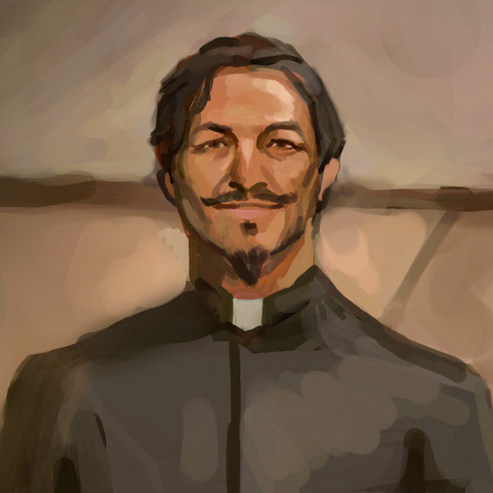
Emilio Sandoz
Quote
- Source
Lorem ipsum dolor sit amet, consectetur adipiscing elit. Ut elit tellus, luctus nec ullamcorper mattis, pulvinar dapibus leo.
Table of Contents
Biography
Early Life
La Perla, Puerto Rico
Emilio Sandoz was a native of Puerto Rico and grew up in La Perla. He was born to Elena Sandoz, whom he later described as a woman of great warmth and a lively nature. Her husband, Miguel, was incarcerated for several years for possession and sale of narcotics; during his absence, Elena had an affair, and Emilio was born nearly a year before her husband returned. Emilio was visibly darker-skinned than the rest of the family, a fact that made his illegitimacy apparent. His mother and her husband did not divorce, however Miguel was abusive towards Emilio from a young age, a situation Emilio later described with grim humor.
Sandoz’s childhood was marked by family violence and criminal activity. He also grew up amid the neighborhood’s pervasive violence and drug trade, sampling product himself as a child and becoming familiar with its effects. According to later accounts, involvement in narcotics trafficking, in particular of black tar herion, was a family tradition: his grandfather was assassinated in prison, his father’s death precipitated a minor gang war, and his brother was eventually killed for skimming profits.
Physically small and good-looking, Sandoz did not conform to local macho ideals of being “feo, fuerte y formal” (ugly, strong and serious) and was subjected to abuse by his peers. He compensated by cultivating a serious, correct demeanor, which persisted into adulthood and was often interpreted by others as sullen or hostile. Despite this reserve, he cultivated a fondness for comedy films, which he watched repeatedly with his brother.
As an adolescent, Sandoz came to the attention of D. W. Yarbrough, a Jesuit priest working in La Perla, who took an interest in him and provided guidance, including instruction in self-defense. At age fourteen, Sandoz “changed the rules of the game” with his mother’s husband, having been taught by Yarborough that it was ok to fight in self defense.
After an incident that resulted in charges for both Sandoz and his brother, Yarbrough arranged to have the charges against Sandoz dropped and helped him leave the island, acting quickly amid concerns for his safety. His brother also avoided conviction, though he continued to blame Emilio for what had happened. At the time, Sandoz intended only to lie low until he turned eighteen, imagining a future that might include boxing, moving to New York, or returning to drug dealing if necessary.
Although acquaintances later learned fragments of his background, Sandoz rarely spoke of his family. Those close to him noted his silence on the subject and the ambivalence it provoked in natives of La Perla. He later stated that he had not decided to become a priest in childhood; rather, exposure to the Jesuits, and particularly to Yarbrough, showed him a different way of life. He acknowledged that gratitude played a role in his choice, but emphasized that he consciously wanted that life and did not regret it.
High School and Formation
At fifteen, the idea of becoming a priest would have seemed laughable to Sandoz, who displayed an explosive temperament which was gradually tempered through lessons in patience and obedience.
His first months at the Jesuit high school were challenging. He was academically behind his peers, though his life experience set him apart. Few students spoke to him except to provoke him, and he often responded in kind. D.W. Yarbrough advised him to control his anger and avoid physical confrontations. Nobody from his family wrote, called, or visited him. Toward the end of his first semester, Yarborough informed him that his brother had avoided legal consequences for the trouble they had both been in, but he continued to blame Emilio. In response, Sandoz resolved not to show vulnerability and briefly ran away from the school. He engaged with a prostitute and returned to the school, defiant, with no indication from others that his absence had been noticed.
Over time, Emilio began to adapt to the structured life of the boarding school. The orderliness and predictability of daily routines appealed to him, and he excelled in Latin, eventually winning a prize for excellence. Despite frequent debates with priests and skepticism about many religious teachings, he was challenged to seek the core truths of faith. Gradually, he experienced a sense of emotional release and a loosening of the burdens from his past.
At seventeen, Emilio entered the Jesuit novitiate. His life experiences, including encounters with brutality and fear, were seen as comparable to those of Ignatius of Loyola, the founder of the Society of Jesus. The disciplined, purposeful, and celibate life of the order resonated with him, particularly in contrast to his earlier experiences of power-driven sexual encounters.
Jesuit formation included the novitiate, classical and humane studies, philosophy, regency (teaching in Jesuit high schools), and advanced theology leading to ordination, followed by tertianship and final vows. Throughout his training, he maintained a personal engagement with faith, acknowledging his doubts while continuing to pray and reflect.
Sandoz excelled academically, developing near-proficiency in Greek and acquiring French (reading only), Italian, and Portuguese to support his scholarly research. He accepted the Jesuit vows fully, viewing them as essential for service in the Apostolate. Following ordination, he pursued a doctorate in linguistics and was expected to secure a professorship at a Jesuit university. Colleagues remembered him as disciplined, intensely focused, and formidable in both academics and extracurricular pursuits. His advanced training in anthropological linguistics guided his study of language and its relation to culture and behaviour.
Jesuit Assigments
During his early career, Sandoz was assigned to a series of international teaching and humanitarian posts.
Reforestation Project
Sandoz’s first assignment was to help organize a reforestation project while teaching at Xavier High School on Chuuk in the Caroline Islands. Originally expected to last six years, the assignment lasted thirteen months, from July 2011 to August 2012, before he was reassigned. In 2060, Felipe Reyes confirmed that the trees planted on Chuuk Island had matured.
Adult Literacy Program
Following his assignment in Chuuk, Sandoz was relocated to an Inuit town just below the Arctic Circle, where he spent twelve months, from August 2012 to August 2013, assisting a Polish priest in establishing an adult literacy program. During his time there, he encountered the challenges of extreme cold and darkness, and struggled with feelings of resentment and disorientation, expressing difficulty in adapting to the local conditions and in learning Polish and Inupiaq.
To pass the long Arctic nights, Sandoz practiced magic tricks from a book he found. What began as a solitary pastime became a skill that he later made use of when interacting with children.
Despite these personal challenges, Felipe Reyes later emphasized the good that Sandoz had accomplished there, noting that a man who had learned to read and write as a teenager in the Jesuit literacy program became a revered poet, his work illuminated by Arctic landscapes and the lives of his people.
Kenyan Refugee Relief Station
"I am still amazed that I picked up three languages that year. It just happened. I stopped thinking of myself as a linguist." "What did you think of yourself as?" "A priest," he said simply.
After his year in the Arctic, Sandoz was assigned to a Christian enclave in southern Sudan, where he worked for approximately twelve months, from August 2013 to August 2014, at a relief station serving Kenyan refugees. He collaborated with a priest from Eritrea named Tahad Kesai, assisting primarily with the care and feeding of refugees, including many children, in extremely challenging conditions. During this period, he gained practical experience in multiple languages, learning three in the field, and described the work as consuming nearly all of his time and energy.
During his service in Sudan Sandoz met a young refugee, Kalingemala Lopore, who would later become Pope Gelasius III. Lopore, later recounted to Sandoz the harrowing journey his family had endured during a time of drought and war, including the death of his youngest sister in his mother’s arms. Sandoz helped the family find shelter in a camp for Gikuyu refugees, providing water, food, and digging a grave for the child. Lopore reflected on this encounter, noting Sandoz’s extraordinary care amid the overwhelming crisis.
Sandoz’s reflections on this period, as well as his work in Chuuk and the Artic Circle, highlighted experiences of generosity, selflessness, and spiritual insight, moments in which he felt close to knowing God.
Sandoz reacted to his early reassignment from Sudan to John Carroll University in the United States with a mixture of resignation and incredulous amusement. He described the reassignment as “the punchline to a three-year joke,” reflecting both the abruptness of the change and the absurdity of moving from a humanitarian field post to an academic AI project.
AI Linguistics Program
"I’m sorry, Tahad, it’s too hard to explain," gasped Sandoz, who was on his way to Cleveland to serve as intellectual carrion for an AI vulture, ad majorem Dei gloriam. "It’s the punchline to a three-year joke."
From August 2014 to May 2015, Sandoz was assigned to John Carroll University near Cleveland, Ohio, to collaborate with Sofia Mendes, an Artificial Intelligence specialist. Mendes was tasked with codifying and computerizing Sandoz’s field language-learning methods. The project aimed to preserve his techniques for the benefit of future missionaries, his superiors paying a “great deal of money” for the project due to his language learning expertise. During this time, Sandoz also taught Latin and graduate linguistics seminars at the university where he found relief and intellectual companionship in his Latin 101 student, Anne Edwards.
His meetings with Mendes occurred three mornings per week and involved intensive sessions in which she questioned Sandoz in detail about his strategies, techniques, and habits for acquiring and analyzing languages in the field. The sessions were demanding, often leaving him mentally exhausted, and Mendes maintained a strict, no-nonsense approach, focusing solely on the work.
Initially, Sandoz was concerned by Mendes’ hostility towards him, which he discussed with Anne, coming to the conclusion that it was likely rooted in historical and cultural memory. Mendes was Sephardic, possibly from the Balkans, and may have associated him, consciously or not, with centuries-old grievances stemming from imperial Catholic Spain. Recognizing this, Sandoz adjusted his approach and moderated his manner around Mendes. He avoided small talk and focused strictly on the question-and-answer rhythm that suited her, which allowed the work to proceed more smoothly and eased some of the tension between them. During this time they discovered shared insights, having both utilized songs to build grammatical understanding of languages based on their genre and form.
The transition from Sudan to the suburban campus in Cleveland was disorienting for Sandoz. He was initially unsettled and angered by the abundance and frivolity he saw around him in Cleveland compared with the suffering he had witnessed and helped to alleviate in Sudan. He found respite in his friendship with Anne Edwards and her husband George. Their house became his refuge; a place where a Jesuit was welcome and could relax off-duty, soaking up energy instead of being drained of it. It was the first real home Emilio Sandoz had ever had.
Return to Puerto Rico
"La Perla ain’t forgot nothin’, son. Won’t be no welcome-home parties." "I know, D.W.," Emilio said seriously. "That’s why I should go back. I need to put some ghosts to rest."
After completing his assignment at John Carroll University, Sandoz formally requested reassignment to La Perla, Puerto Rico, where he had grown up. Although the request should have been reviewed through the Antilles Province, it was instead handled directly by D.W. Yarbrough, the Provincial in New Orleans at the time. Despite offering Sandoz a professorship at Le Moyne College in Syracuse, Yarbrough ultimately approved the request. The transfer was accepted without comment by the relevant provincials.
In December 2015, Sandoz contacted Anne and George Edwards from San Juan and invited them to join him in Puerto Rico. The Jesuit clinic in La Perla was losing its National Service doctor, and Sandoz asked Anne, a physician, to take over the position. After discussion, Anne and George agreed to relocate. In May 2016, they moved into a rented house in Old San Juan, near the clinic, and Anne assumed responsibility for its operations. Sandoz took time off to help them settle.
Sandoz resumed work in La Perla by cleaning and organizing the mission’s physical plant, surveying existing resources, and reestablishing connections in the neighborhood. He initially worked within existing programs, including a baseball league and after-school activities, while identifying children with potential for further education. He used informal methods to connect children with George Edwards, a retired engineer, for tutoring and technical exposure. During this period, he introduced Maria Lopez, an eleven-year-old girl, to the clinic as Anne’s first assistant, and mentored Felipe Reyes, a boy who sold stolen goods outside the clinic, eventually involving him in Mass and work at the Jesuit Center.
To address tension and distance between the mission staff and older residents of La Perla, Anne proposed holding a community gathering at the clinic. The resulting fiesta was well attended and led to a series of similar events. These gatherings combined food and entertainment with public health efforts such as immunizations, contraceptive distribution, blood pressure checks, and lice screenings. Attendance at the clinic increased following these events, often revealing long-neglected medical problems. Community engagement gradually improved.
Through George Edwards’s voluntary work at Arecibo Radio Telescope, Sandoz became acquainted with Jimmy Quinn, a radio astronomer who frequently visited San Juan and La Perla and developed a close friendship with Sandoz and the Edwardses. Sandoz and Quinn would frequently meet at Claudio’s Bar for drinks, Quinn feeling safe in La Perla despite the dangers to outsiders as he was known to be a friend of Emilio’s.
Several months after returning to Puerto Rico, Sandoz was assaulted while visiting his brother. He sustained facial injuries and a broken rib and was treated by Anne Edwards at the clinic. He did not publicly disclose the circumstances of the assault, offering different explanations to different people and only telling Anne “I tried, Anne. I gave it an honest try”. In the aftermath, community response toward him became noticeably warmer, with residents offering assistance and food. Attendance at Mass increased significantly, and Sandoz celebrated despite his injuries.
Felipe Reyes later emphasized Sandoz’s lasting influence in the community, citing, among other examples, Julio Mondragón, a former vandal whom Sandoz encouraged to paint the chapel and who later became a successful and widely recognized artist.
Discovery of Alien Signal
"Our own existence, as a species and as individuals, is improbable. The fact that we know one another appears to be a result of chance. And yet, here we are. And now we have evidence that another sentient species exists nearby and that they sing. They sing, Anne." She felt his hands squeeze hers. "We have to find out about them. There is simply no alternative. We have to know them."
In early 2019 Jimmy Quinn was assigned to collaborate with what colleagues referred to as a “Vulture”; a consultant whose aim was to automate routine tasks using Artificial Intelligence in order to bring down staffing costs at Arecibo. Sandoz advised Quinn to request Sofia Mendes for this work due to her expertise in the field, suggesting that if the end results were poor, it could leave him remembered as mediocre.
Quinn proposed a pilot project to Dr. Masao Yanoguchi and ISAS to compare an AI program with his own work in radio astronomy, aiming to assess the reliability of AI in automating his routine tasks. He suggested enlisting Sofia Mendes as the AI analyst, structuring the project competitively so that her broker would receive triple her normal fee if successful, but nothing if the program failed. The proposal, including Mendes’ clearly defined success criteria, was approved by ISAS after negotiation, allowing the collaboration to proceed.
Upon arriving at the Arecibo Radio Telescope, Sofia Mendes was introduced to George Edwards, on whom she relied for orientation and support as she acclimated to the project. During this period, George invited her to dinner with him and Anne, which she accepted. Mendes’ working relationship with Jimmy Quinn was collaborative and professional; while Quinn was personally attracted to her, Mendes remained focused on the technical aspects of the AI project.
On August 2nd 2019 Jimmy Quinn and Sofia Mendes attended a dinner hosted by George and Anne, a grouping suggested to them by Sandoz, bringing together several overlapping personal relationships. Quinn’s well-known infatuation with Mendes was apparent throughout the evening, while Mendes remained reserved. The gathering took an unexpected turn when music led to a spontaneous piano and vocal duet between Mendes and Sandoz, revealing a strong understanding and personal connection between them. The moment was unusually intimate, and intensified existing tensions, particularly for Quinn, whose disappointment became evident and prompted his early departure.
Despite Sandoz’s priesthood, Quinn, as well as Anne, were able to see the potential for a romantic relationship between Sandoz and Mendes. In an attempt to distract himself from feelings of jealousy, Quinn went home and accessed the Arecibo’s dish system remotely, choosing to “make good” on the excuse he gave for leaving the dinner early to catch up on work.
A short time later, Quinn identified an anomalous signal during routine analysis of deep-space radio data. Noticing the transmission resembled structured patterns rather than noise, Quinn followed a hunch and processed the signal through a digital audio program. The result revealed a complex, clearly nonhuman form of music; vocal in nature, layered with rhythm and harmonic structure unlike any known traditions on Earth. After extensive checks to eliminate local, military, or artificial sources, Quinn confirmed that the signal was extraterrestrial and traced its origin to the Alpha Centauri system, approximately four light-years from Earth. At approximately 3:57am, after three hours of reviewing the signal convinced him that it was both coherent and artificial in origin, he called Anne, wanting to share the discovery with his friends first. Initially, he asked Anne to get George online to listen, but Anne insisted that they all gather at Arecibo; “If this is real, then virtual reality isn’t good enough. I want real reality.” Anne, George, Emilio and Sofia met Jimmy at the Radio Telescope around 6am.
As the group listened repeatedly to the transmission, discussion quickly turned from confirmation to interpretation. Anne identified social implications in the presence of choral singing and a lead voice, suggesting organized culture and shared aesthetic values. Sandoz focused on the linguistic qualities embedded in the music, identifying structures and syntactic repetition that implied a spoken language, and began transcribing elements of it. George analyzed the technological implications of radio transmission, outlining the necessary scientific knowledge (electricity, metallurgy, chemistry, wave theory) required to produce such a signal. Mendes evaluated the discovery in systemic terms, notingthat existing AI screening methods would not have discovered the signal, as well as the broader economic and logistical implications of sustained interstellar communication.
The discovery immediately sparked the group’s imagination about visiting the source of the signal. Quinn began mapping potential courses to Alpha Centauri, while George outlined how asteroid‑based life‑support systems could make the journey feasible. Mendes assessed the logistical and technical requirements, showing that such a mission could, in principle, be organized. Anne, though skeptical, offered anthropological and medical insight, grounding the discussion in practical concerns. Sandoz, deeply moved, highlighted the cultural and spiritual significance of encountering an alien civilization firsthand, declaring the prospect not only possible but a moral imperative to pursue. Together, their combined expertise transformed the distant signal into the real possibility of humanity’s first contact with another species.
Reaction to the Signal
But he was beginning to find it hard to avoid thinking that if ever a man had wanted a sign from God, Emilio Sandoz had been hit square in the face with one this morning, at Arecibo.
Confirmation of the Alpha Centauri signal moved rapidly from Jimmy’s initial discovery to global disclosure on Sunday, August 3, 2019. Within hours of Quinn’s initial report, independent confirmation was secured by Goldstone Observatory, triggering immediate international coordination among major radio astronomy facilities. Telescopes worldwide were redirected toward Alpha Centauri, and by the evening a live, globally broadcast press conference from Arecibo formally announced the discovery. Public reaction was swift and intense: the alien music spread almost instantly across digital networks, while scientific institutions, governments, and the United Nations asserted competing claims over stewardship of the data, ultimately reaffirming long‑standing agreements that extraterrestrial signals belonged to all humanity.
While the general public quickly became enthralled, the media’s attention was punctuated by claims of hoaxes and misinterpretations of the music, prompting radio astronomers worldwide to intensify monitoring efforts. Despite the eventual decline in public coverage, scientific scrutiny remained intense, with researchers attempting to confirm the authenticity of the signal and seeking additional transmissions. By mid-September, multiple signals had been verified, quelling doubts about fabrication and establishing a foundation for long-term investigation.
Spiritually, the discovery intensified long-standing tensions in Sandoz’s faith. A Jesuit priest who openly acknowledged his own agnosticism, he did not experience the alien signal as a comforting confirmation of God’s presence. Instead, he felt profoundly alone in the universe, even as he could not escape the thought that the signal might be the kind of sign he had never dared ask for. He oscillated between doubt and a fragile serenity, reassuring himself by trusting the institutional wisdom of the Society and his superiors rather than his own judgment.
Emotionally, Sandoz was also grappling with his attraction to Mendes, which challenged his vows of celibacy. He accepted this conflict without self-deception, viewing it as something to be disciplined over time rather than denied. Throughout this period, he maintained a composed, rational demeanor with others, carefully presenting the mission as cautious, reversible, and ethically defensible, even as he privately questioned whether the unfolding precision of events was human design or something beyond his control.
By the end of this period, Sandoz was at a crossroads: outwardly the steady planner and linguist likely to be assigned to the mission to Alpha Centauri, inwardly a man haunted by doubt, responsibility, and a dawning sense that a door had opened in the universe, and in his own soul, that could never again be closed.
Rakhat Mission
Since proposing the mission, Emilio had been taken aback by the pace of things. What had begun in laughter, almost as a joke, was snow-balling, changing lives. Already, time and money were being spent in quantities that staggered him. And if the speed of events scared him, the precision with which the pieces were falling into place was even more unnerving. He went sleepless, unable to decide which was harder to live with: the idea that he had started all this, or the possibility that God had.
Within the Jesuit hierarchy, the signal prompted an immediate response. Father General Tomás da Silva deemed the discovery to be of profound divine significance and never doubted its authenticity. Though the process appeared abrupt to outsiders, the selection of the crew followed hundreds of man-hours of research, fierce internal debate over including non-Jesuits, and careful consideration of historical precedent favoring a mixed team with broad expertise.
Mission Preparation and Training
Sandoz’s key contribution to mission preparations was in serving as the quiet intermediary between the Society and his friends, who had the relevant skills to be listed as potential crew members. On September 16th he arranged a dinner between D. W. Yarborough and the Edwardses as an informal, domestic encounter rather than a formal interview. By doing so, trust, compatibility, and temperament were evaluated naturally, resulting in Yarborough offering them places on the mission, at the same time confirming that Sandoz and Quinn were also crew candidates, with Yarborough acting as commander due to his background in the Marines.
Initially, the Jesuits were only willing to engage Mendes by contracting her services through her broker Jaubert, a limitation she accepted without expectation, however she was quietly freed from her contract to Jaubert when an anonymous donation paid it off in full. Afterwards, acting independently, her connections allowed for the anonymous purchase of an appropriate vessel on behalf of the Society of Jesus. She officially joined the mission through a similarly informal process as the Edwardses. After contacting Sandoz and expressing her desire not just to facilitate the voyage but to serve as a crew member, Sandoz relayed her offer to his superiors, and she also met Yarborough in a casual setting. Impressed by her intelligence, work ethic, and ability to support morale during the long mission, Yarborough effectively confirmed her place on the crew, with final approval deferred to his superiors.
Stella Maris Voyage
Lorem ipsum dolor sit amet, consectetur adipiscing elit. Ut elit tellus, luctus nec ullamcorper mattis, pulvinar dapibus leo.
Arrival and First Contact
Lorem ipsum dolor sit amet, consectetur adipiscing elit. Ut elit tellus, luctus nec ullamcorper mattis, pulvinar dapibus leo.
Exploration and Activities
Lorem ipsum dolor sit amet, consectetur adipiscing elit. Ut elit tellus, luctus nec ullamcorper mattis, pulvinar dapibus leo.
Challenges and Conflicts
Lorem ipsum dolor sit amet, consectetur adipiscing elit. Ut elit tellus, luctus nec ullamcorper mattis, pulvinar dapibus leo.
Massacre at Kashan
Lorem ipsum dolor sit amet, consectetur adipiscing elit. Ut elit tellus, luctus nec ullamcorper mattis, pulvinar dapibus leo.
City of Gayjur
Lorem ipsum dolor sit amet, consectetur adipiscing elit. Ut elit tellus, luctus nec ullamcorper mattis, pulvinar dapibus leo.
Recovery by Magellan Crew
Lorem ipsum dolor sit amet, consectetur adipiscing elit. Ut elit tellus, luctus nec ullamcorper mattis, pulvinar dapibus leo.
Return to Earth
Public Reaction and Controversy
Lorem ipsum dolor sit amet, consectetur adipiscing elit. Ut elit tellus, luctus nec ullamcorper mattis, pulvinar dapibus leo.
Convalescence
Lorem ipsum dolor sit amet, consectetur adipiscing elit. Ut elit tellus, luctus nec ullamcorper mattis, pulvinar dapibus leo.
Long-Term Effects
Lorem ipsum dolor sit amet, consectetur adipiscing elit. Ut elit tellus, luctus nec ullamcorper mattis, pulvinar dapibus leo.
Naples 2060-2061
Jesuit Hearings
Lorem ipsum dolor sit amet, consectetur adipiscing elit. Ut elit tellus, luctus nec ullamcorper mattis, pulvinar dapibus leo.
Jesuit Collaboration
Lorem ipsum dolor sit amet, consectetur adipiscing elit. Ut elit tellus, luctus nec ullamcorper mattis, pulvinar dapibus leo.
Relationship with Gina Giuliani
Lorem ipsum dolor sit amet, consectetur adipiscing elit. Ut elit tellus, luctus nec ullamcorper mattis, pulvinar dapibus leo.
Return to Rakhat
Lorem ipsum dolor sit amet, consectetur adipiscing elit. Ut elit tellus, luctus nec ullamcorper mattis, pulvinar dapibus leo.
Giordano Bruno Voyage
Lorem ipsum dolor sit amet, consectetur adipiscing elit. Ut elit tellus, luctus nec ullamcorper mattis, pulvinar dapibus leo.
Arrival and Landing
Lorem ipsum dolor sit amet, consectetur adipiscing elit. Ut elit tellus, luctus nec ullamcorper mattis, pulvinar dapibus leo.
Exploration and Activities
Lorem ipsum dolor sit amet, consectetur adipiscing elit. Ut elit tellus, luctus nec ullamcorper mattis, pulvinar dapibus leo.
Challenges and Conflicts
Lorem ipsum dolor sit amet, consectetur adipiscing elit. Ut elit tellus, luctus nec ullamcorper mattis, pulvinar dapibus leo.
Later Life
Lorem ipsum dolor sit amet, consectetur adipiscing elit. Ut elit tellus, luctus nec ullamcorper mattis, pulvinar dapibus leo.
Physical Description
Lorem ipsum dolor sit amet, consectetur adipiscing elit. Ut elit tellus, luctus nec ullamcorper mattis, pulvinar dapibus leo.
Personality and Traits
Lorem ipsum dolor sit amet, consectetur adipiscing elit. Ut elit tellus, luctus nec ullamcorper mattis, pulvinar dapibus leo.
Skills
Lorem ipsum dolor sit amet, consectetur adipiscing elit. Ut elit tellus, luctus nec ullamcorper mattis, pulvinar dapibus leo.
Relationships
Lorem ipsum dolor sit amet, consectetur adipiscing elit. Ut elit tellus, luctus nec ullamcorper mattis, pulvinar dapibus leo.
Quotes
Lorem ipsum dolor sit amet, consectetur adipiscing elit. Ut elit tellus, luctus nec ullamcorper mattis, pulvinar dapibus leo.
Etymology
Lorem ipsum dolor sit amet, consectetur adipiscing elit. Ut elit tellus, luctus nec ullamcorper mattis, pulvinar dapibus leo.
Behind the Scenes
Lorem ipsum dolor sit amet, consectetur adipiscing elit. Ut elit tellus, luctus nec ullamcorper mattis, pulvinar dapibus leo.
Born
La Perla, Puerto Rico
Nationality
Full Name
Also Known As
Title(s)
Occupation
Jesuit Priest
Linguist
Marital Status
Physical
Species
Gender
Hair Colour
Eye Colour
Relationships
Family
Children
Grandchildren
Romances
Affiliations
John Carroll University
Status
Date of Death
Cause of Death
Other
First Appearance
Chapter 1
Last Appearance
Coda
Art Credit